Forms Are More Flexible Than You Think
At their core, forms are just a structured way to collect information. But “structured” doesn’t have to mean rigid. A well-designed form can guide someone through a complex process, filter out the wrong leads, gather everything you need before a first call, or make a client feel like you already understand their business before you’ve even spoken.
Here are a few ways that can look in practice.
1. The Contact Form, Done Right
Most contact forms are an afterthought. They ask for a name and an email, maybe a message, and then… nothing. The person submits it and wonders if anyone will ever respond.
A thoughtful contact or inquiry form does more than collect info. It sets expectations. A confirmation message that explains when you’ll be in touch, a question or two to understand what someone is looking for, or even just a warm, human “thank you” goes a long way.
We’ve built contact forms for clients that quietly qualify leads before they ever hit the inbox, asking about timeline, budget range, or project type, so the conversation that follows is actually useful from the first word.
2. Intake and Order Forms
For service businesses, the intake form might be the most important form on your site.
Think about how much time gets spent in back-and-forth emails before a project even starts. “Can you tell me a bit more about what you’re looking for?” “What’s your timeline?” “Do you have existing brand assets?” A well-built intake form handles all of that upfront, and signals to clients that you run a tight ship.
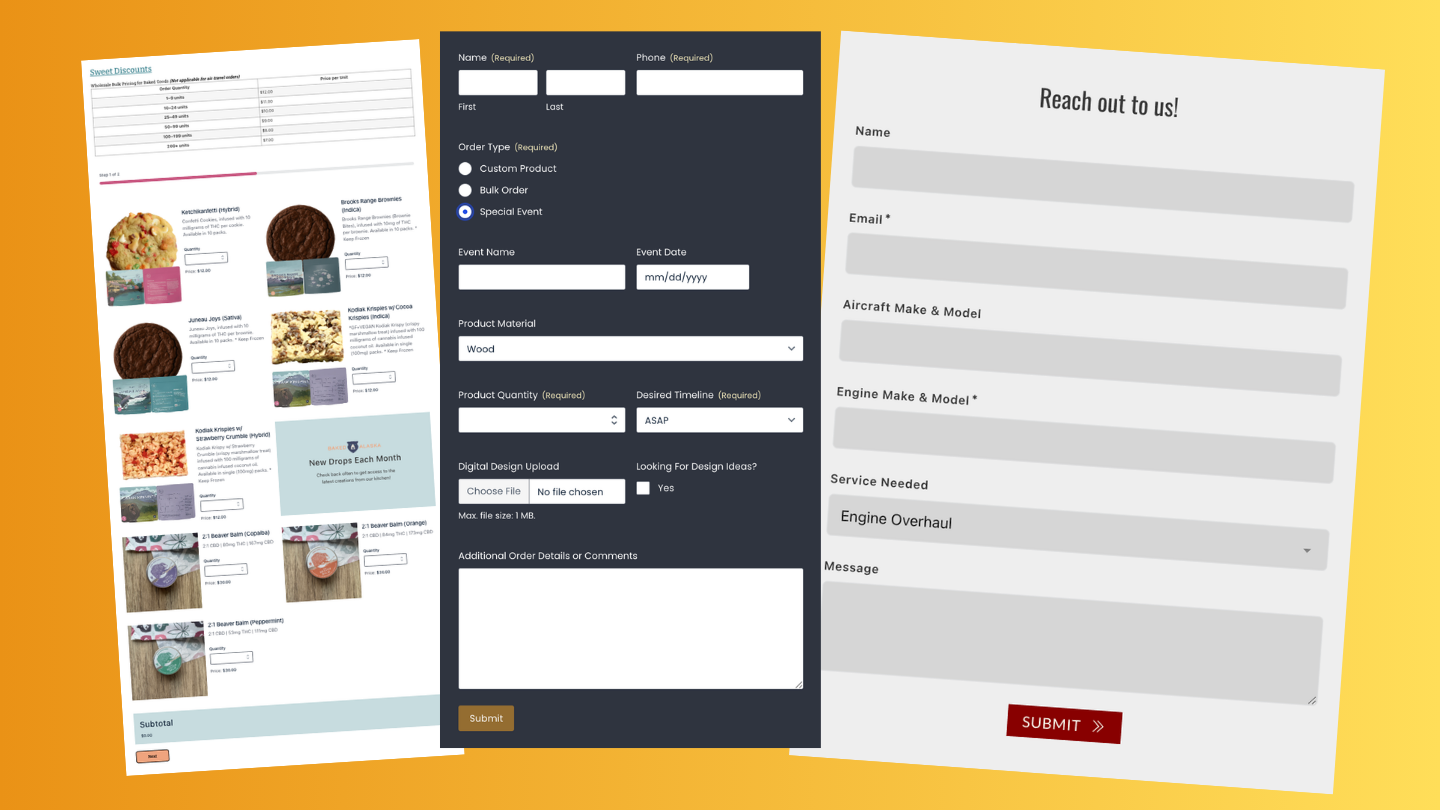
For product-based businesses, custom order forms can replace entire email threads. Fabric choices, sizing, personalization details, shipping preferences – all collected cleanly before anyone has to pick up the phone.
The result: less friction for the client, less back-and-forth for you.
3. Multi-Step and Conditional Forms
This is where things get genuinely interesting.
A multi-step form breaks a longer process into digestible chunks, one question or section at a time, so it doesn’t feel overwhelming. Completion rates go up. Frustration goes down. Users know exactly where they are in the process, improving their experience on your website.
Conditional logic takes it further. The form adapts based on what you tell it. If a customer selects “I’m looking for a bulk order”, they see questions relevant to that scope. If they select “I want a one-of-a-kind product,” they get a different path. It’s a personalized experience built right into the intake process.
We’ve built forms like this for clients who serve multiple types of customers, and the difference in the quality of information they receive (and the time saved sorting through it) is significant.
The Takeaway
A form doesn’t have to be boring, and it doesn’t have to be a bottleneck. It can be a genuine asset that works for you around the clock, collects exactly what you need, and makes every client interaction a little smoother.
If the form on your site is doing the bare minimum, it might be time to ask, “What else can my website’s form for do for my business?“